Cold isostatic pressing (CIP) equipment is used to compact powdered materials by applying pressure uniformly from multiple directions through a liquid pressure-transmitting medium. The technology is widely used in ceramics, powder metallurgy, graphite production, advanced materials research, and industrial manufacturing.
By compressing powders inside flexible molds, cold isostatic presses help create compact shapes with relatively uniform density before further operations such as sintering, machining, or heat treatment.
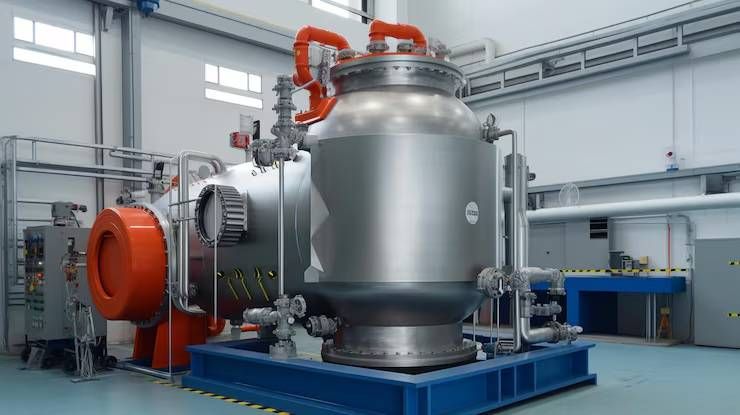
Unlike conventional mechanical presses that apply force mainly along one axis, cold isostatic pressing distributes pressure around the mold. This approach is useful when producing components with complex geometries, larger dimensions, or demanding density requirements. Equipment ranges from laboratory-scale presses for experimental work to industrial systems designed for repeated production cycles.
Context
What Is Cold Isostatic Pressing?
Cold isostatic pressing is a powder compaction technique based on the transmission of pressure through a fluid. Powder is placed inside a flexible, sealed mold, which is then exposed to high fluid pressure inside a pressure vessel. The mold compresses around the powder, forming a solid-shaped compact commonly called a green body.
The compact is not necessarily a fully dense, finished component. Depending on the material, it may undergo sintering or another subsequent operation to develop its required strength, density, and structural properties.
How Cold Isostatic Pressing Developed
Isostatic pressing developed from the principles of fluid pressure transmission and advances in high-pressure engineering. Manufacturers adopted the technique to address limitations associated with conventional powder pressing, including uneven density caused by friction between powder and rigid tooling.
Over time, improvements in pressure vessels, flexible molds, hydraulic systems, seals, and digital controls expanded the technology's applications. Modern equipment can accommodate different chamber sizes, pressure ranges, loading arrangements, and levels of automation.
Main Types of Cold Isostatic Pressing Equipment
Cold isostatic presses are commonly classified according to how the mold interacts with the pressure medium.
| Equipment Type | Main Operating Principle | Typical Applications |
|---|---|---|
| Wet bag CIP press | A sealed mold is immersed directly in the pressure fluid | Research, complex shapes, varied production batches |
| Dry bag CIP press | The mold remains integrated into the press assembly | Repeated production of similar components |
| Laboratory CIP press | Compact pressure vessel for small experimental batches | Material research and formulation testing |
| Industrial CIP press | Larger vessel and loading arrangement | Ceramic, graphite, and metal powder compaction |
| Automated CIP system | Integrates pressure control and selected handling operations | Repeated manufacturing cycles |
The main distinction between wet bag and dry bag systems is the relationship between the mold and the pressure vessel. Wet bag systems provide flexibility for different mold configurations, whereas dry bag systems can support more automated production of established component designs. <Cite refs={["turn671282search1","turn671282search3"]}/>
Importance
Why Cold Isostatic Pressing Matters
Powdered materials do not always compact evenly when pressure is applied from a single direction. Friction between the powder and rigid tooling can create variations in density, potentially affecting shrinkage, strength, and dimensional consistency during later processing.
Cold isostatic pressing helps reduce these variations by transmitting pressure around the mold. This is particularly useful for materials that are difficult to form using conventional mechanical presses.
Ceramics and Refractory Manufacturing
Technical ceramics are used in applications that require electrical insulation, wear resistance, thermal stability, or chemical resistance. Cold isostatic pressing can compact ceramic powders into shapes such as tubes, rods, sleeves, and other components that undergo further treatment.
Refractory materials also use powder compaction to produce components intended for high-temperature industrial environments. The resulting compact may require drying, sintering, or additional machining before use.
Powder Metallurgy and Metal Components
In powder metallurgy, metal powders are consolidated into shaped bodies before further manufacturing operations. CIP is particularly relevant to selected applications requiring relatively uniform density or geometries that are difficult to compact with conventional tooling.
The method is used in research and production involving specialized metal components, carbide materials, and selected alloy systems. Suitability depends on powder characteristics, mold design, required dimensions, and the final material specifications.
Graphite and Advanced Materials
Graphite products are used in furnaces, electrodes, thermal systems, and other industrial equipment. Cold isostatic pressing can help form graphite powder into larger or more uniform compact shapes before subsequent thermal treatment.
The technology also supports research involving composite powders and advanced materials. Different formulations may require specialized molds and carefully controlled pressure cycles.
Factors That Influence Pressing Quality
Several variables influence the quality of a compact:
Powder particle size and distribution.
Powder flow and packing characteristics.
Mold material and geometry.
Applied pressure and holding time.
Pressure increase and release rates.
Moisture content and powder preparation.
Mold sealing and pressure vessel condition.
Subsequent sintering or thermal treatment.
Uniform pressure does not eliminate every source of defects. Powder preparation, mold design, trapped air, and later thermal treatment can all affect the finished component.
Recent Updates
Automation and Digital Pressure Control
Developments through 2024–2026 reflect continued interest in automated powder compaction, digital monitoring, and repeatable pressure cycles. Modern CIP systems may incorporate programmable pressure settings, automated loading arrangements, pressure sensors, and recorded operating data.
These functions help operators monitor process conditions and reproduce established production sequences. Their availability depends on the equipment model and installation.
Equipment for Different Production Scales
Manufacturers continue to develop systems ranging from small research presses to large industrial pressure vessels. This range supports both laboratory investigations and production involving larger ceramic or powder-based components.
Vertical and horizontal loading configurations are used according to factory layout, component dimensions, and handling requirements. <Cite refs={["turn671282search3","turn671282search10"]}/>
Growing Interest in Advanced Materials
Cold isostatic pressing remains relevant to research involving technical ceramics, semiconductor materials, graphite, metal powders, and selected battery-related materials. Researchers use the technique to study how compaction pressure and powder characteristics influence density and later material behavior.
The growing range of advanced material formulations creates different requirements for tooling, pressure control, and downstream treatment.
Integration With Broader Manufacturing Workflows
CIP is commonly integrated with powder preparation, drying, machining, sintering, and inspection. Manufacturing facilities increasingly evaluate these stages together because the quality of the compact affects subsequent operations.
Digital records can help connect pressing parameters with inspection results and material batches. Process validation remains necessary when changing powder formulations, molds, or operating conditions.
Laws or Policies
Pressure Vessel Safety
Cold isostatic presses operate at elevated fluid pressures, making pressure vessel integrity and safe operation essential. Equipment design may require appropriate vessel construction, pressure relief devices, seals, interlocks, inspection, and maintenance procedures.
In India, applicable workplace safety and pressure equipment obligations depend on the installation, facility, and relevant regulations. Equipment operators should follow the manufacturer's technical documentation and the requirements that apply to their location.
Machinery and Electrical Standards
International standards can support machinery risk assessment and electrical safety. ISO 12100 addresses machinery safety and risk assessment, while IEC 60204-1 covers electrical equipment of machines where applicable.
Pressure vessel requirements may also depend on the governing engineering codes, design conditions, and jurisdiction. Compliance should be evaluated for the complete installation rather than inferred from the use of a particular technology.
Worker and Material Safety
Powder handling can generate airborne particles, while hydraulic systems and moving equipment introduce additional workplace hazards. Suitable dust control, protective equipment, training, guarding, and operating procedures depend on the materials and equipment involved.
Some powders require special precautions because of their chemical or physical properties. Laboratories and factories should use appropriate material safety documentation and established handling procedures.
Environmental Considerations
CIP operations may generate rejected compacts, used mold materials, contaminated fluids, and powder residues. Waste handling depends on the composition of the material and the applicable environmental requirements.
Appropriate collection, storage, and disposal procedures help limit exposure and environmental contamination.
Tools and Resources
Equipment Specifications and Technical Manuals
Manufacturer documentation describes pressure capacity, vessel dimensions, mold arrangements, loading systems, hydraulic controls, and operating limits. These details help determine whether a particular press suits the material and component geometry.
Users should also examine pressure monitoring, safety interlocks, maintenance requirements, and the availability of compatible molds.
Powder Characterization Equipment
Powder preparation and characterization influence the performance of CIP systems. Common laboratory instruments include particle size analyzers, moisture measurement equipment, density measurement tools, and powder flow testing instruments.
These measurements help researchers understand how powders behave during mold filling and compaction.
Manufacturers and Technical Resources
Several manufacturers publish technical information about cold isostatic pressing equipment:
KOBE STEEL, LTD. describes wet bag and dry bag CIP configurations for different production requirements.
Quintus Technologies documents systems ranging from laboratory-scale presses to large industrial equipment.
Nikkiso Co., Ltd. describes CIP applications involving ceramics, semiconductor materials, metals, graphite, and related products.
Their published equipment ranges and applications can be explored through their official websites. <Cite refs={["turn671282search1","turn671282search3","turn671282search10"]}/>
Material Testing and Inspection
After pressing and subsequent treatment, components may undergo inspection using density measurement, dimensional checks, microscopy, or mechanical testing. The selected methods depend on the material and the intended application.
Inspection helps determine whether the component meets the required specifications and whether adjustments to powder preparation or pressing parameters are necessary.
FAQs
What is cold isostatic pressing equipment used for?
Cold isostatic pressing equipment compacts powders into shaped bodies using pressure transmitted through a fluid. It is used in ceramic manufacturing, powder metallurgy, graphite production, advanced materials research, and industrial component preparation.
What is the difference between wet bag and dry bag CIP?
Wet bag systems use a flexible mold immersed directly in the pressure medium. Dry bag systems keep the mold integrated into the press arrangement, supporting more automated production when the component design and manufacturing sequence are relatively consistent.
Which materials can be processed using cold isostatic pressing?
Common materials include ceramic powders, metal powders, graphite, refractory materials, and selected composites. The appropriate process depends on powder characteristics, mold compatibility, required component dimensions, and downstream treatment.
How does cold isostatic pressing differ from hot isostatic pressing?
Cold isostatic pressing compacts powders at or near ambient temperature using fluid pressure. Hot isostatic pressing uses elevated temperature and high gas pressure, often to densify materials or reduce internal porosity in previously formed components.
What factors affect the quality of a CIP compact?
Powder characteristics, mold design, applied pressure, pressure cycle, moisture content, and subsequent treatment all influence compact quality. Proper equipment maintenance and consistent operating procedures also contribute to repeatability.
Conclusion
Cold isostatic pressing equipment compacts powders by applying fluid pressure around a flexible mold, helping produce shaped bodies with relatively uniform density. Wet bag, dry bag, laboratory, and industrial systems support different materials and production requirements. Powder characteristics, mold design, pressure control, and subsequent treatment influence the quality of the resulting components. Safe pressure vessel operation, appropriate material handling, and suitable inspection procedures remain essential throughout the manufacturing process.