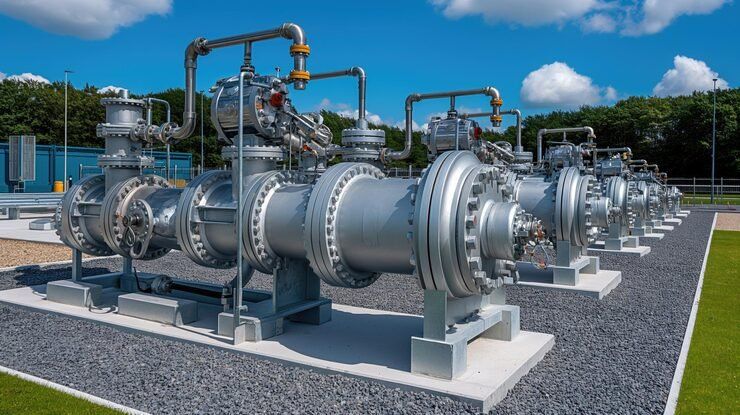
Industrial pumping systems are engineered assemblies used to move, circulate, transfer, pressurize, or control liquids and other process fluids across industrial facilities. A complete system can include pumps, motors, valves, piping, tanks, filters, instrumentation, control panels, and monitoring equipment.
These systems are used in water treatment, chemical processing, oil and gas, power generation, mining, food processing, pharmaceuticals, manufacturing, and other industries where controlled fluid movement is essential.
Why Industrial Pumping Systems Matter
Industrial processes frequently require fluids to move between storage tanks, processing equipment, treatment systems, cooling circuits, and distribution networks. Pumping equipment provides the pressure and flow required to maintain these operations.
System performance depends on pump selection, fluid characteristics, pressure requirements, flow rate, piping configuration, temperature, and operating conditions.
A properly engineered system can also incorporate variable-speed drives and automated controls to adjust pump operation according to changing process demand.
Types of Industrial Pumps
Different pump technologies are designed for different flow, pressure, fluid, and operating requirements.
Centrifugal Pumps
Centrifugal pumps use rotating impellers to transfer energy to the fluid. They are widely used for water circulation, cooling systems, process fluids, and general fluid transfer.
Positive Displacement Pumps
Positive displacement pumps move a defined volume of fluid during each operating cycle. They are useful for applications requiring controlled flow or higher pressure.
Diaphragm Pumps
Diaphragm pumps use a flexible membrane to move fluid. Their design can be suitable for chemicals, slurries, corrosive fluids, and applications requiring isolation between the fluid and mechanical components.
Gear Pumps
Gear pumps use rotating gears to transport fluid. They are commonly applied to viscous liquids, oils, lubricants, and selected chemical processes.
Screw Pumps
Screw pumps use one or more rotating screws to provide continuous fluid movement. They can be used for viscous fluids and applications requiring relatively smooth flow.
Piston Pumps
Piston pumps use reciprocating pistons to generate fluid movement and can support high-pressure applications.
Pumping Technologies
Modern industrial pumping systems combine mechanical equipment with hydraulic, electrical, and digital technologies.
| Technology | Function |
|---|---|
| Variable-frequency drive | Controls motor speed |
| Pressure sensors | Monitor system pressure |
| Flow meters | Measure fluid movement |
| PLC control | Automates pump operation |
| Remote monitoring | Tracks operating conditions |
| Variable-speed pumping | Matches output to demand |
| Pump skid systems | Integrates multiple components |
Variable-frequency drives can adjust pump speed according to process requirements. This can help systems operate more efficiently when demand changes.
Industrial Pumping System Manufacturing Process
Manufacturing and assembly depend on the pump design and system configuration.
1. Engineering and Design
Engineers establish flow rate, pressure, fluid properties, temperature, materials, pump configuration, motor capacity, and control requirements.
2. Pump Component Manufacturing
Components such as casings, impellers, shafts, gears, seals, bearings, and housings are manufactured according to required specifications.
3. Pump Assembly
The components are assembled and aligned. Bearings, seals, couplings, motors, and other supporting components are integrated according to the pump configuration.
4. Skid and Piping Assembly
For packaged systems, pumps can be mounted on structural skids together with valves, piping, filters, instrumentation, and control equipment.
5. Electrical and Control Integration
Motors, variable-frequency drives, PLCs, sensors, control panels, and communication systems are connected and configured.
6. Testing and Inspection
Systems can undergo pressure testing, flow testing, vibration checks, electrical testing, leakage inspection, and performance verification.
Automation in Industrial Pumping Systems
Automation allows pumping systems to respond to changing process conditions. Sensors can monitor flow, pressure, temperature, vibration, and tank levels.
PLC-based control systems can automatically start or stop pumps, switch between duty and standby units, adjust pump speed, and generate alarms.
More advanced systems can connect pumps to supervisory control and data acquisition platforms or industrial monitoring networks. Data can then be used to identify performance changes and maintenance requirements.
Industrial Pumping System Comparison
| Pump Type | Main Characteristic | Common Applications |
|---|---|---|
| Centrifugal | Continuous flow | Water and process fluids |
| Diaphragm | Fluid isolation | Chemicals and slurries |
| Gear | Handles viscous fluids | Oils and lubricants |
| Screw | Smooth continuous flow | Viscous process fluids |
| Piston | High pressure | Specialized process systems |
| Positive displacement | Controlled volume | Metering and transfer |
Industrial Pump Cost Factors
The overall cost of an industrial pumping system depends on pump type, capacity, pressure rating, materials, motor size, control technology, piping configuration, automation, and installation requirements.
Additional factors can include skid construction, valves, filtration, instrumentation, electrical panels, variable-frequency drives, spare equipment, commissioning, and maintenance infrastructure.
For demanding applications, corrosion-resistant materials, specialized seals, high-pressure components, or automated monitoring can increase system complexity.
Global Manufacturers and Suppliers
The industrial pump market includes pump manufacturers, equipment suppliers, distributors, engineering companies, and system integrators.
When comparing an industrial pump manufacturer or supplier, technical considerations can include:
Pump capacity
Pressure rating
Fluid compatibility
Materials of construction
Motor configuration
Efficiency characteristics
Control options
Spare-parts availability
Testing capabilities
System integration requirements
For complete pumping installations, a supplier may provide individual pumps, packaged skid systems, or an integrated pumping solution.
Industrial Applications
Industrial pumping systems are used across numerous sectors:
Water and wastewater treatment
Chemical processing
Oil and gas
Power generation
Mining and mineral processing
Food and beverage manufacturing
Pharmaceutical production
Plastics manufacturing
Metal processing
HVAC and cooling systems
Pulp and paper production
General manufacturing
In wastewater facilities, pumps move untreated water, treated water, sludge, and other process streams. In chemical plants, specialized materials and seals may be required to handle corrosive or hazardous fluids.
How to Select an Industrial Pumping System
Before selecting a system, evaluate:
Required flow rate
Required pressure or head
Fluid composition
Fluid temperature
Viscosity
Corrosion and abrasion characteristics
Pump operating cycle
Motor and electrical requirements
Automation requirements
Maintenance and redundancy needs
The complete hydraulic system should be considered rather than selecting a pump based only on its rated capacity. Piping losses, valves, fittings, elevation changes, and operating conditions all affect the final pump requirement.
Frequently Asked Questions
What is an industrial pumping system?
An industrial pumping system is an integrated arrangement of pumps and supporting equipment used to transfer, circulate, pressurize, or control fluids in industrial processes.
What are the main industrial pump types?
Common types include centrifugal, positive displacement, diaphragm, gear, screw, and piston pumps.
What factors determine pump selection?
Flow rate, pressure, fluid properties, temperature, viscosity, materials, operating cycle, and automation requirements are important selection factors.
What is a pump skid system?
A pump skid is a packaged assembly that can integrate pumps, motors, piping, valves, filters, instrumentation, and controls on a structural frame.
Where are industrial pumping systems used?
They are used in water treatment, chemical processing, oil and gas, power generation, mining, food processing, pharmaceuticals, manufacturing, and cooling systems.
Conclusion
Industrial pumping systems provide controlled fluid movement across a wide range of manufacturing and processing environments. Centrifugal, positive displacement, diaphragm, gear, screw, and piston pumps address different combinations of flow, pressure, viscosity, and fluid characteristics.
Modern systems increasingly combine pumps with variable-speed drives, sensors, PLCs, automated controls, and remote monitoring. Selecting the appropriate system requires consideration of hydraulic requirements, fluid properties, equipment materials, automation, maintenance, and the complete process configuration.