Plastic Molding Machines
These machines transform plastic materials into products with specific shapes, dimensions, and functional properties. They are widely used in packaging, automotive, construction, electronics, healthcare equipment, and household product manufacturing.
Different plastic molding technologies support different production requirements. Understanding their operating principles, machine types, materials, and industrial applications helps explain how plastic products are manufactured.
Understanding Plastic Molding Machines
Plastic molding machines are industrial equipment designed to shape polymer materials into predetermined forms. Depending on the technology, plastic is heated, softened, melted, compressed, or forced into a mold or forming system.
The finished product takes the shape of the mold or manufacturing equipment. Once the material cools, hardens, or solidifies, the component can be removed for further processing.
How Plastic Molding Machines Work
Although machine designs differ, most plastic molding operations follow several basic stages:
Material preparation: Plastic granules, pellets, or other suitable raw materials are prepared for processing.
Heating and softening: Heat is applied to make the material suitable for shaping.
Molding or forming: The material enters a mold or passes through a forming system.
Cooling and solidification: The shaped material becomes firm enough to maintain its dimensions.
Product removal: The finished component is separated from the mold or production equipment.
Inspection: Products are checked for dimensional accuracy, surface quality, and manufacturing defects.
The exact sequence depends on the molding technology and the properties of the polymer being processed.
Importance in Modern Manufacturing
Plastic molding supports the production of complex shapes, lightweight components, and standardized products. Manufacturers use these processes to produce components in different sizes, thicknesses, colors, and material compositions.
The technology also supports repeatable production, making it suitable for industries that require consistent product dimensions and manufacturing quality.
Types of Plastic Molding Machines
Several types of plastic molding machines are used across industrial manufacturing. Each technology has specific operating principles and suitable product applications.
Injection Molding Machines
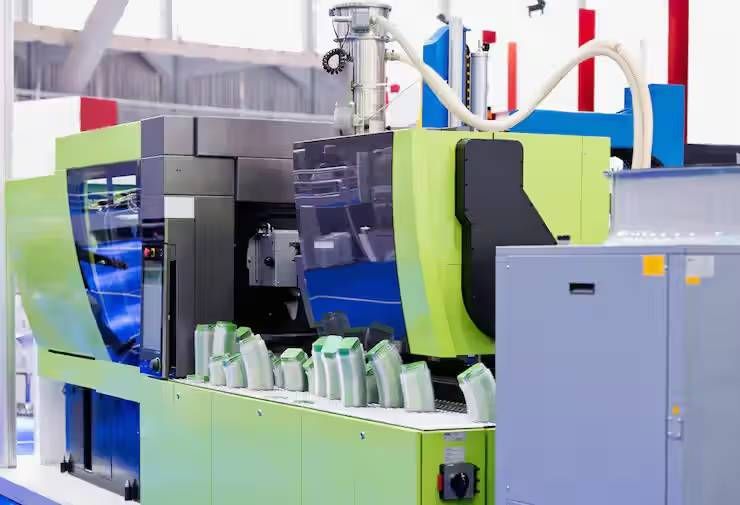
Injection molding machines melt plastic material and inject it into a closed mold under controlled pressure. The material cools inside the mold and takes the required shape.
These machines commonly manufacture:
Automotive interior and exterior components
Electrical enclosures and connectors
Plastic containers and household products
Medical equipment components
Consumer electronics housings
Injection molding is widely used for producing detailed components in repeated production cycles.
Blow Molding Machines
Common applications include plastic bottles, containers, storage tanks, and packaging products. Extrusion blow molding and injection blow molding are two commonly used variations.
Compression Molding Machines
Compression molding machines shape plastic materials by applying heat and pressure inside a mold cavity. The material spreads through the mold and solidifies into the required form.
This method is commonly associated with thermosetting plastics and certain composite materials. Applications include electrical components, industrial parts, and molded structural products.
Extrusion Molding Machines
Plastic extrusion machines continuously push softened polymer material through a shaped opening called a die. The resulting material has a consistent cross-sectional profile.
Typical products include plastic pipes, tubes, sheets, films, and profiles. Extrusion is particularly suitable for continuous manufacturing operations.
Rotational Molding Machines
Rotational molding machines produce hollow plastic products by heating and rotating a mold along multiple axes. The material gradually spreads across the internal mold surfaces.
This technology is commonly used for manufacturing water tanks, storage containers, playground equipment, and large hollow industrial products.
Plastic Molding Manufacturing Processes and Materials
The manufacturing process depends on the selected machine, polymer characteristics, product geometry, and production requirements.
Common Plastic Materials
Different polymers have different processing temperatures, strength characteristics, flexibility, and chemical properties.
Common materials include:
Polyethylene (PE): Used in packaging, containers, pipes, and storage products.
Polypropylene (PP): Commonly used in automotive components, household products, and packaging.
Polyvinyl Chloride (PVC): Used in pipes, fittings, profiles, and construction materials.
Acrylonitrile Butadiene Styrene (ABS): Used in electronic housings, automotive components, and consumer products.
Polyethylene Terephthalate (PET): Commonly used in beverage bottles and food packaging.
Polystyrene (PS): Used in packaging, disposable products, and selected industrial components.
Material selection depends on the product's intended function, environmental conditions, and manufacturing method.
Manufacturing Process Comparison
Process | Main technique | Common products |
|---|---|---|
Injection molding | Material injected into a mold | Components and housings |
Blow molding | Air expands plastic inside a mold | Bottles and containers |
Compression molding | Heat and pressure shape material | Industrial and electrical parts |
Extrusion molding | Material passes through a die | Pipes and plastic sheets |
Rotational molding | Heated mold rotates on multiple axes | Tanks and hollow products |
Importance of Plastic Molding Machine Selection
Selecting appropriate equipment is important for maintaining production consistency, product quality, and efficient manufacturing operations. Different machines have different technical requirements, production capabilities, and operating characteristics.
Key Equipment Selection Factors
Several factors should be evaluated before selecting plastic molding equipment:
Production capacity: Determine the required output and production cycle.
Material compatibility: Confirm that the machine supports the intended polymer.
Product dimensions: Consider component size, thickness, and shape complexity.
Mold requirements: Evaluate mold dimensions, design, and compatibility.
Automation features: Examine material feeding, temperature control, product removal, and monitoring systems.
Energy requirements: Consider heating systems, motors, and overall electricity consumption.
Maintenance requirements: Review equipment accessibility, replacement components, and routine maintenance procedures.
Quality Control in Plastic Manufacturing
Quality control helps identify production problems and maintain consistent product specifications. Manufacturers commonly monitor temperature, pressure, cooling conditions, and cycle times.
Common manufacturing defects include:
Warping: Changes in product shape during cooling.
Sink marks: Small depressions caused by uneven material shrinkage.
Short shots: Incomplete filling of the mold cavity.
Flash: Excess material appearing around mold edges.
Surface defects: Marks, scratches, or irregular finishes.
Proper machine settings, mold maintenance, and material handling help reduce these issues.
Industrial Applications of Plastic Molding Machines
Plastic molding technologies are used in many manufacturing sectors because polymers can be shaped into products with different mechanical and physical characteristics.
Major Industry Applications
Automotive: Interior panels, dashboards, connectors, and protective components.
Packaging: Bottles, caps, containers, and protective packaging materials.
Construction: Pipes, fittings, insulation components, and window profiles.
Electronics: Equipment housings, switches, cable components, and protective enclosures.
Healthcare: Selected medical equipment components, laboratory containers, and packaging.
Consumer goods: Furniture components, kitchenware, toys, and household accessories.
The manufacturing process and material must be suitable for the intended application, particularly when products require specific safety, durability, or regulatory characteristics.
Frequently Asked Questions
What are plastic molding machines used for?
They manufacture plastic products by heating, shaping, compressing, or forming polymer materials into specific designs.
Which types of plastic molding machines are commonly used?
Injection molding, blow molding, compression molding, extrusion molding, and rotational molding machines are commonly used.
Which materials are suitable for plastic molding?
Common materials include polyethylene, polypropylene, PVC, ABS, PET, and polystyrene. Compatibility depends on the molding process.
What factors influence plastic molding machine selection?
Production capacity, material compatibility, product dimensions, mold design, automation, energy requirements, and maintenance needs are important considerations.
What is the difference between injection molding and extrusion?
Injection molding produces individual components by filling a mold, whereas extrusion continuously forms plastic through a shaped die.
Conclusion
Plastic molding machines are essential equipment in various manufacturing industries. Different technologies support the production of hollow containers, automotive components, packaging materials, pipes, and household products. Understanding machine types, polymer materials, manufacturing processes, and equipment requirements provides a useful foundation for evaluating plastic molding operations.