Industrial bakery equipment includes specialized machinery used to prepare ingredients, mix dough, shape products, proof, bake, cool, inspect, and package baked goods at commercial production scale. Modern bakery production lines can combine mechanical equipment, ovens, conveyors, sensors, automation systems, and packaging machinery to create controlled and repeatable workflows.
Equipment selection depends on the type of bakery product, production capacity, recipe characteristics, required throughput, plant layout, and level of automation.
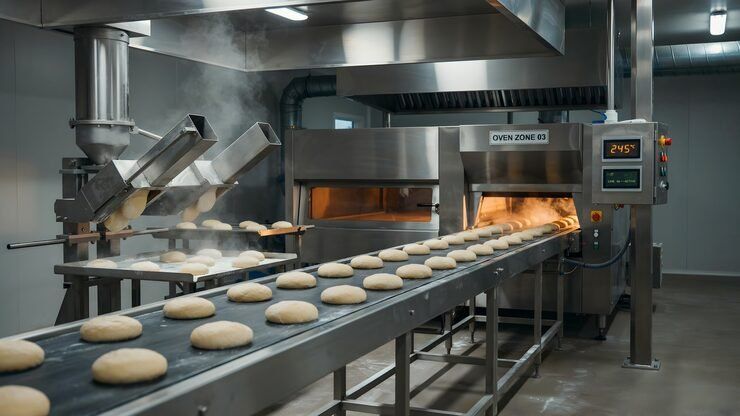
What Is Industrial Bakery Equipment?
Industrial bakery equipment refers to machinery designed to support large-scale production of bread, rolls, buns, biscuits, cookies, pastries, cakes, pizza bases, and other baked products.
A production line may include:
Ingredient handling systems
Flour sifters
Industrial mixers
Dough dividing machines
Dough rounders
Sheeters and molders
Proofing systems
Industrial ovens
Cooling conveyors
Metal detectors
Packaging machines
Labeling systems
Individual machines can operate as standalone units or as part of an integrated automated production line.
Key Bakery Processing Technologies
Ingredient Handling
Automated ingredient handling systems can transfer flour, sugar, fats, liquids, yeast, and other ingredients to designated processing equipment.
Silos, hoppers, pumps, weighing systems, and pneumatic conveying equipment can be integrated into larger facilities.
Industrial Mixing
Industrial mixers combine ingredients to create dough or batter with the required consistency.
Common mixer configurations include spiral mixers, planetary mixers, horizontal mixers, and continuous mixing systems. Selection depends on the formulation, batch size, viscosity, and production requirements.
Dough Processing
Dough processing equipment can divide, round, sheet, laminate, mold, or deposit dough into specific shapes and weights.
These machines help standardize product dimensions and support continuous production.
Proofing
Proofing systems provide controlled temperature and humidity conditions that allow yeast-leavened dough to develop before baking.
Continuous proofers can use conveyors and environmental controls to maintain defined process conditions.
Types of Industrial Bakery Equipment
| Equipment Type | Main Function | Typical Application |
|---|---|---|
| Industrial mixer | Ingredient and dough mixing | Bread, rolls, dough products |
| Dough divider | Divides dough into portions | Bread and bun production |
| Dough rounder | Shapes dough portions | Rolls and bread |
| Sheeter | Reduces dough thickness | Pastry and bakery products |
| Proofer | Controlled fermentation | Yeast-based products |
| Industrial oven | Baking | Bread, cookies, cakes |
| Cooling conveyor | Product cooling | Post-baking handling |
| Depositor | Controlled product depositing | Cakes, cookies, pastries |
| Packaging machine | Product packing | Finished bakery products |
The exact combination depends on the product and production workflow.
Industrial Bakery Production Process
A typical automated bakery production process includes several stages.
1. Ingredient preparation: Raw ingredients are weighed, screened, transferred, and prepared according to the formulation.
2. Mixing: Ingredients are combined in industrial mixers to produce dough or batter.
3. Dividing: Dough is divided into controlled portions.
4. Forming: Dough portions are rounded, sheeted, molded, deposited, or otherwise shaped.
5. Proofing: Products requiring fermentation pass through controlled proofing equipment.
6. Baking: Industrial ovens apply controlled heat according to the product recipe and process requirements.
7. Cooling: Baked products move through cooling conveyors or controlled cooling systems.
8. Inspection: Vision systems, metal detectors, checkweighers, or other equipment can inspect finished products.
9. Packaging: Automated systems can fill, seal, label, code, and pack bakery products.
Baking Technologies
Different oven technologies are used according to product characteristics and production requirements.
Tunnel Ovens
Tunnel ovens use continuous conveyors to transport products through multiple temperature zones. They are widely suited to continuous bakery production.
Rotary Rack Ovens
Rotary rack systems rotate product racks during baking to promote consistent heat exposure. They can support a variety of bakery products.
Deck Ovens
Deck ovens provide separate baking surfaces or chambers and are often used where controlled baking conditions are important.
Convection Ovens
Convection ovens circulate heated air to transfer heat efficiently around the product.
Automation in Bakery Production
Automation can connect multiple bakery machines into a coordinated production line.
PLC systems can control mixers, conveyors, ovens, proofers, pumps, valves, and other equipment. Sensors can monitor temperature, speed, weight, humidity, product position, and other process parameters.
Machine vision can inspect product shape, color, dimensions, surface conditions, and packaging.
Automated packaging systems can integrate feeding, filling, sealing, coding, labeling, checkweighing, and case packing.
Global Manufacturers and Suppliers
The industrial bakery equipment market includes specialized machinery manufacturers, oven producers, processing-equipment companies, automation providers, and complete bakery-line integrators.
Companies such as GEA, Bühler, Baker Perkins, Reading Bakery Systems, AMF Bakery Systems, Mecatherm, and WP Bakerygroup provide bakery processing technologies and equipment for different production applications.
Suppliers may provide individual machines or integrated production lines covering mixing, forming, proofing, baking, cooling, inspection, and packaging.
When evaluating suppliers, manufacturers can consider throughput, equipment configuration, product compatibility, automation capabilities, energy requirements, sanitation features, maintenance access, documentation, and integration experience.
Industrial Applications
Industrial bakery equipment supports production across several product categories.
Bread and Rolls
Automated lines can combine mixing, dividing, rounding, proofing, baking, cooling, slicing, and packaging.
Biscuits and Cookies
Depositors, rotary molders, wire-cut machines, tunnel ovens, cooling systems, and packaging equipment can be integrated into cookie and biscuit production.
Cakes and Pastries
Industrial depositors, mixers, ovens, cooling systems, filling equipment, and decorating machines can support cake and pastry production.
Pizza Products
Dough processing, sheeting, forming, topping, baking, cooling, and packaging systems can be configured for pizza bases and related products.
How to Select Industrial Bakery Equipment
Selecting equipment requires an understanding of the entire production process.
1. Define the product: Identify product type, dimensions, formulation, weight, and baking characteristics.
2. Establish capacity: Determine batch size, production rate, operating hours, and required throughput.
3. Evaluate automation: Decide which processes should be manual, semi-automated, or fully automated.
4. Review equipment compatibility: Ensure mixers, conveyors, ovens, proofers, inspection systems, and packaging machines can operate together.
5. Assess hygiene requirements: Consider cleanability, food-contact materials, access, and sanitation procedures.
6. Examine energy requirements: Evaluate oven heating systems, insulation, heat recovery, and overall energy consumption.
7. Consider maintenance: Review accessibility, wear components, spare parts, training, and preventive maintenance requirements.
Frequently Asked Questions
What is industrial bakery equipment?
Industrial bakery equipment is machinery used for large-scale preparation, processing, baking, cooling, inspection, and packaging of bakery products.
What machines are used in an industrial bakery?
Common machines include mixers, dough dividers, rounders, sheeters, molders, proofers, ovens, cooling conveyors, inspection systems, and packaging machines.
How does an industrial bakery production line work?
Ingredients are prepared and mixed, dough is divided and shaped, products are proofed when required, baked, cooled, inspected, and packaged.
What types of industrial bakery ovens are available?
Common configurations include tunnel ovens, rotary rack ovens, deck ovens, and convection ovens. The appropriate system depends on product and production requirements.
How do manufacturers choose bakery equipment?
Selection typically considers product characteristics, production capacity, automation level, hygiene requirements, equipment compatibility, energy consumption, maintenance, and plant layout.
Conclusion
Industrial bakery equipment provides the machinery needed to transform ingredients into finished bakery products through controlled mixing, dough processing, proofing, baking, cooling, inspection, and packaging operations.
Modern production lines can integrate automation, sensors, machine vision, industrial ovens, conveyors, and packaging systems to create coordinated manufacturing workflows. Selecting suitable equipment requires consideration of product characteristics, production volume, process requirements, hygiene, energy use, maintenance, and integration capabilities.